
9th Class Mathematics Pairing Scheme 2027 – Complete Marks Distribution
The 9th Class Mathematics Pairing Scheme 2027 is an important study guide for students preparing for their Class 9 Mathematics annual examinations. The chapter-wise paper pattern helps students understand how objective questions, short questions, and long questions are distributed across the textbook.
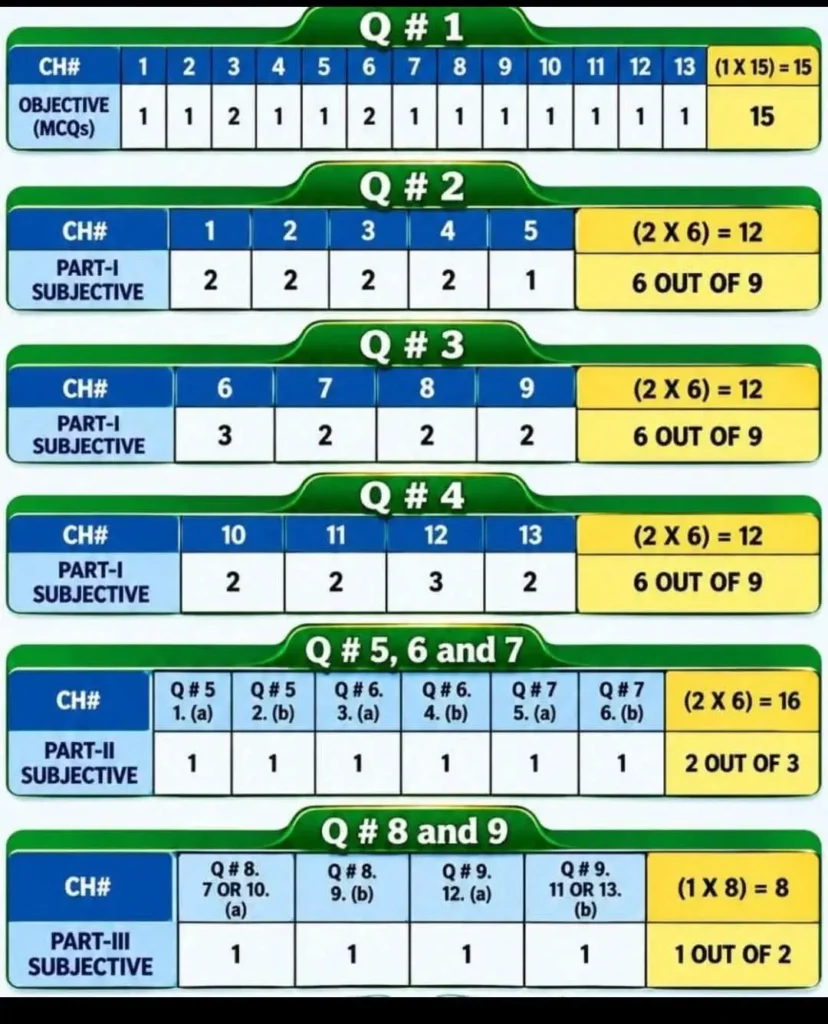
According to the provided pairing scheme image, the Mathematics paper includes questions from all 13 chapters. The paper is divided into objective and subjective portions, with different question choices available in each section. Students can use this scheme to organize their revision, identify important chapters, and practice questions according to the examination pattern.
The 9th Class Mathematics Pairing Scheme 2027 provides a useful overview of chapter coverage. However, students should remember that a pairing scheme is a preparation guide, not a guarantee that the examination will contain only the questions shown in the image.
9th Class Mathematics Paper Pattern 2027
The provided scheme divides the paper into three main parts:
- Part I: Objective questions, including multiple-choice questions (MCQs).
- Part II: Short questions from different chapters.
- Part III: Subjective questions with chapter-wise choices.
The objective section covers Chapters 1 to 13. The subjective section is divided into several questions, allowing students to choose from the given options.
Students should prepare every chapter because the scheme includes the complete textbook rather than focusing on only a few selected chapters.
Chapter-Wise Mathematics Pairing Scheme 2027
The following table summarizes the chapter distribution shown in the uploaded scheme.
| Paper Question | Chapters | Distribution | Marks |
|---|---|---|---|
| Q1: MCQs | Chapters 1–13 | 15 objective questions | 15 |
| Q2: Short Questions | Chapters 1–5 | 9 questions; attempt 6 | 12 |
| Q3: Short Questions | Chapters 6–9 | 9 questions; attempt 6 | 12 |
| Q4: Short Questions | Chapters 10–13 | 9 questions; attempt 6 | 12 |
| Q5, Q6 & Q7 | Part II subjective | Chapter-based subparts and choices | 16 shown in image |
| Q8 & Q9 | Part III subjective | Chapter-based choices | 8 shown in image |
Important: The image shows a total of 15 marks for MCQs, 12 marks each for Q2, Q3 and Q4, 16 marks for Q5–Q7, and 8 marks for Q8–Q9. Students should verify the final marks and question-choice instructions with their board’s official paper pattern because the uploaded image contains some unclear or potentially inconsistent labels.
Chapter-Wise MCQs Distribution
The objective portion contains 15 MCQs from all 13 chapters. The image indicates the following distribution:
- Chapter 1: 1 MCQ
- Chapter 2: 1 MCQ
- Chapter 3: 2 MCQs
- Chapter 4: 1 MCQ
- Chapter 5: 1 MCQ
- Chapter 6: 2 MCQs
- Chapters 7, 8, 9, 10, 11, 12 and 13: 1 MCQ each
Chapter 3 and Chapter 6 have two MCQs each, while the remaining chapters have one MCQ each.
Students should practice definitions, formulas, basic concepts, mathematical properties, and textbook examples to prepare for the objective portion. Regular MCQ practice can help improve accuracy and reduce mistakes during the examination.
Short Questions: Q2, Q3 and Q4
The short-question section is divided into three groups.
Q2 covers Chapters 1 to 5. The scheme shows chapter-wise question distribution of 2, 2, 2, 2 and 1. Students are required to attempt six questions according to the displayed pattern.
Q3 covers Chapters 6 to 9. Chapter 6 has three questions, while Chapters 7, 8 and 9 have two questions each. The image indicates that students must attempt six questions.
Q4 covers Chapters 10 to 13. The distribution is two questions from Chapter 10, two from Chapter 11, three from Chapter 12, and two from Chapter 13. Students should prepare the short exercises and important textbook examples from these chapters.
The 9th Class Mathematics Pairing Scheme 2027 makes it easier to divide short-question preparation into three chapter groups. However, students should practice all available questions rather than depending entirely on selected exercises.
Long Questions and Subjective Paper Preparation
The uploaded scheme also provides chapter-based choices for Q5, Q6 and Q7 in Part II.
The displayed subparts include questions from Chapters 1, 2, 3, 4, 5, 6 and 7. Students should prepare the relevant exercises and understand how to solve each question step by step.
Part III contains Q8 and Q9. The image shows choices involving Chapter 7 or 10, Chapter 9, Chapter 12, and Chapter 11 or 13.
Students should carefully review the question choices and practice complete solutions. Mathematics requires understanding, so memorizing answers without learning the method may create problems when questions are presented differently.
How to Prepare for the 9th Class Mathematics Exam 2027
Students can follow these practical preparation tips:
- Revise all 13 chapters: Do not skip chapters because the objective section covers the complete textbook.
- Practice MCQs daily: Focus on textbook exercises, formulas, and important concepts.
- Prepare short questions: Solve questions from Chapters 1–5, 6–9, and 10–13 separately.
- Practice subjective questions: Write complete solutions and show all necessary mathematical steps.
- Attempt past papers: Use previous papers to improve speed, accuracy, and time management.
- Review mistakes: Revisit incorrect answers and practice similar questions.
Final Words
The 9th Class Mathematics Pairing Scheme 2027 is a helpful resource for students preparing for their annual examinations. It explains the chapter coverage of MCQs, short questions, and subjective questions and provides a starting point for organized revision.
Students should use the scheme alongside their textbook, exercise questions, and past papers. Preparing all 13 chapters and practicing regularly will help them build confidence and improve their performance in the Mathematics examination.

One Comment