3 Fully-Funded MSc, MS and Master’s Scholarships in the US Closing in September 2026
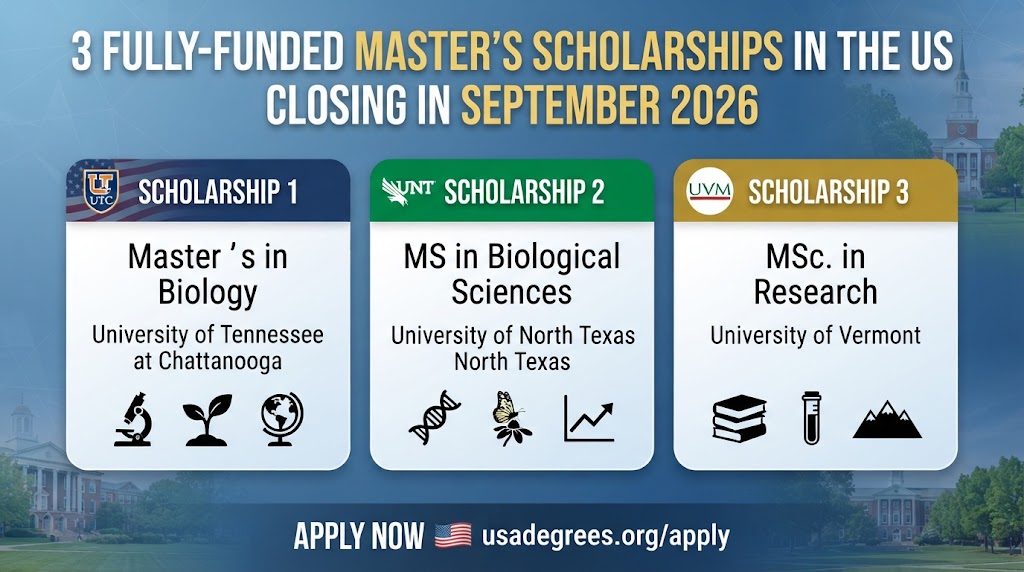
Students planning to pursue a graduate degree in the United States have a limited-time opportunity to apply for three funded MSc, MS and Master’s scholarships. The application deadline for all three opportunities is September 30, 2026, while the selected programs are expected to begin in 2027.
The opportunities are available at the University of Tennessee at Chattanooga, University of North Texas, and University of Vermont. They cover different research areas, including botanical science, insect pollinators, environmental research, and fisheries.
Depending on the program, financial support ranges from $4,500 per semester to $37,000 per year. Some opportunities also provide tuition assistance, health-related benefits, or other support.
US Master’s Scholarships 2026 at a Glance
| University | Degree | Research Area | Funding | Deadline |
|---|---|---|---|---|
| University of Tennessee at Chattanooga | Master’s | Biology, Botany, Environmental Sciences | $4,500 per semester + fee waiver | Sept. 30, 2026 |
| University of North Texas | MS | Biological Sciences, Pollinator Ecology | $26,400–$28,320 per year | Sept. 30, 2026 |
| University of Vermont | MSc | Fisheries Science | $37,000 per year + tuition support | Sept. 30, 2026 |
1. University of Tennessee at Chattanooga Graduate Assistantship
The University of Tennessee at Chattanooga is offering a graduate assistantship for students interested in botanical research, herbarium collections, and related biological sciences.
The selected student will work with the university’s herbarium, which houses more than 50,000 specimens. Responsibilities may include specimen preparation, collection management, digitization, and processing older materials.
The assistantship provides $4,500 per semester along with a $4,806 maintenance and tuition fee waiver. The funding may continue for up to six academic semesters. Additional summer employment may also be available.
Eligibility
Applicants should have a relevant undergraduate degree and a minimum 2.7 GPA. Botanical coursework or practical experience in botany can strengthen an application.
The listed English language requirements include IELTS 6.5, TOEFL iBT 80, or Duolingo English Test 120.
2. University of North Texas MS Studentship
The University of North Texas is offering an MS studentship focused on the relationship between ranch management and insect pollinators.
The research will examine how ranching practices influence pollinators, plants, soil microbes, and habitat conditions. Students may conduct field research at different sites across North Texas and analyze ecological data.
The studentship offers approximately $26,400 to $28,320 annually, together with tuition-related support and health benefits according to the program information.
Eligibility
Applicants generally need a bachelor’s degree in biology, ecology, environmental science, entomology, or a related discipline. The listed minimum GPA is 3.0.
An interest in pollinator ecology, biodiversity, conservation, and field-based ecological research is also relevant.
English requirements listed for the opportunity include IELTS 6.5, TOEFL iBT 79, or PTE Academic 53.
3. University of Vermont MSc Assistantship
The third opportunity is available at the University of Vermont for students interested in fisheries, conservation, and human interactions with aquatic ecosystems.
The MSc research will focus on Lake Champlain and may explore fishing behavior, stakeholder preferences, fish and fisher movement, social networks, and fisheries management.
Depending on the research project, students may work with surveys, interviews, fish sampling, telemetry, genetics, modeling, or network analysis.
The assistantship provides $37,000 per year, along with tuition support and a living allowance. The program is expected to begin in January 2027.
Eligibility
Candidates should meet the university’s graduate admission requirements and have an academic background related to fisheries science, ecology, environmental studies, geography, sociology, anthropology, natural resources, data science, or a similar field.
The listed minimum GPA is 3.0. English language requirements include IELTS 6.5, TOEFL iBT 90, or Duolingo English Test 110.
What Do These Scholarships Cover?
These fully funded Master’s scholarships in the USA provide financial assistance in different forms. The exact package depends on the university and assistantship.
Support can include a monthly or annual stipend, tuition assistance, fee waivers, living support, and health-related benefits. Students also gain practical research experience while completing their graduate studies.
However, applicants should carefully check the funding conditions for their specific program because not every benefit applies in exactly the same way to every student.
Documents Students May Need
Before applying, candidates should prepare the documents requested by their selected university. These may include:
- Academic transcripts
- Degree or graduation documents
- Updated CV or resume
- Statement of purpose or personal statement
- Letters of recommendation
- English language test results, where required
- Research-related material, if requested
Some research-based programs may also recommend contacting a potential supervisor before submitting the application.
How to Apply for the US Scholarships
Students should first choose the opportunity that matches their academic background and research interests. They should then review the official graduate admission requirements and assistantship instructions.
Because each university has a separate application process, candidates should not assume that one application automatically covers all three opportunities.
The deadline for these US Master’s scholarships 2026 is September 30, 2026. Students should submit their applications before the deadline and make sure all required documents have been uploaded successfully.
With the deadline approaching, applicants should also allow enough time for recommendation letters, language test documents, transcripts, and other supporting materials.
Final Reminder for Applicants
These three opportunities provide different routes into graduate research in the United States. The right option depends on the student’s previous education, research interests, GPA, English language qualification, and career plans.
Students interested in botany, biological sciences, pollinator ecology, fisheries, conservation, or environmental research should review the relevant program carefully before applying. The funding amount and eligibility conditions vary, so checking the university’s latest official instructions is essential.
Deadline: September 30, 2026.